Loudspeaker Modeling with Simscape Acoustics
R2026bThis example shows how to model linear and nonlinear components of a dynamic loudspeaker using the Simscape Acoustics library.
Introduction to Loudspeaker Modeling
Dynamic loudspeaker drivers convert electrical signals into acoustic waves using electromagnetic energy to produce mechanical movements in a cone-shaped diaphragm. Therefore, three main domains must be represented in the model: electrical, mechanical, and acoustic, in addition to the bidirectional energy conversions between these.
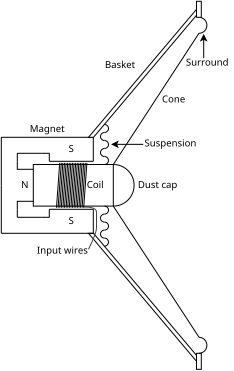
A common linear model for a loudspeaker is to represent it as an electrical circuit, which is known as a lumped element model. The mechanical and acoustic effects are represented by electrical circuits that are mathematically equivalent models.
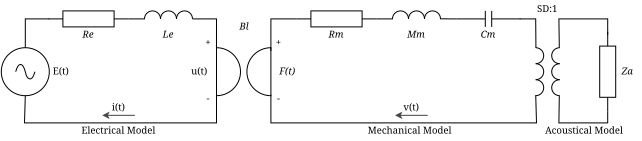
For the electrical model, the motor is composed of the voice coil and the magnet. The voice coil is driven by a voltage  and has a resistance
  and an inductance
  . These two parameters depend on the wire material, diameter, length, turn radius, number of turns, and other physical properties. The magnet also has an impact on the coil inductance because of the addition of a ferrous core.
The magnet creates a field in the gap with a flux density  . Multiplied by the wire length
  , this is known as the force factor
  . This is also the conversion factor between the electrical and mechanical domains, as there is a force
  applied to the voice coil, where
  is the electrical current applied at the input. Inversely, there is a voltage
  generated by
  which is analogous to the cone velocity. When converting the mechanical model to an electrical model, the coupling between them is represented by a gyrator, where velocity corresponds to the electrical current and force corresponds to the voltage.
For the mechanical model, lumped electrical components are used as analogues to mechanical properties such as mass and compliance. First, the inertia of the total moving mass (including the coil, cone, and dust cap) is analogous to the effect of an inductance  on varying electrical currents. Second, the stiffness of the suspension and spider is analogous to the effect of a capacitor
  . Thirdly, the mechanical loss in the suspension system is analogous to a resistor
  . This mechanical model forms a circuit with resonant frequency
  , which implies that the efficient frequency range of the driver depends on its mass.
For the acoustic model, the driver cone surface interface with the air is analogous to a transformer. The larger the cone is, the more mechanical energy is transformed to acoustic energy (at least for a given mass). An impedance  (formed by
  ,
,  and
and  ) models the radiation resistance for the front and the back of the cone. For a non-enclosed driver, this value is nonlinear but relatively small. An enclosed driver has a fixed amount of air, which creates a compliance modeled by a capacitor , and any air leaks (including a vent) will contribute to the resistance . For a vented enclosure, the mass of air moving in and out acts as an inductor .
For simplicity, the remainder of this example assumes a loudspeaker in free space, i.e. no enclosure ( ).
).
The equation for the electrical part of the model is:

The equation for the mechanical part of the model is:

Where: 
The equations for a gyrator are:


Linear Loudspeaker Model with Mixed Domains
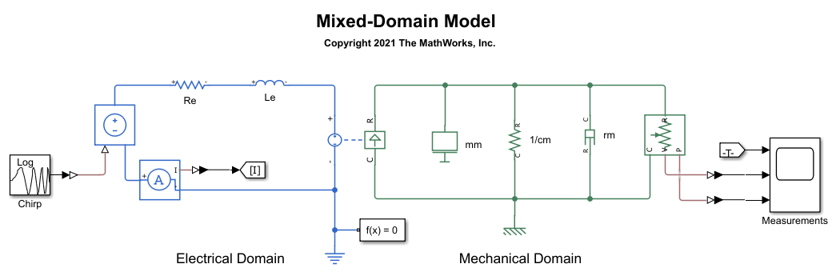
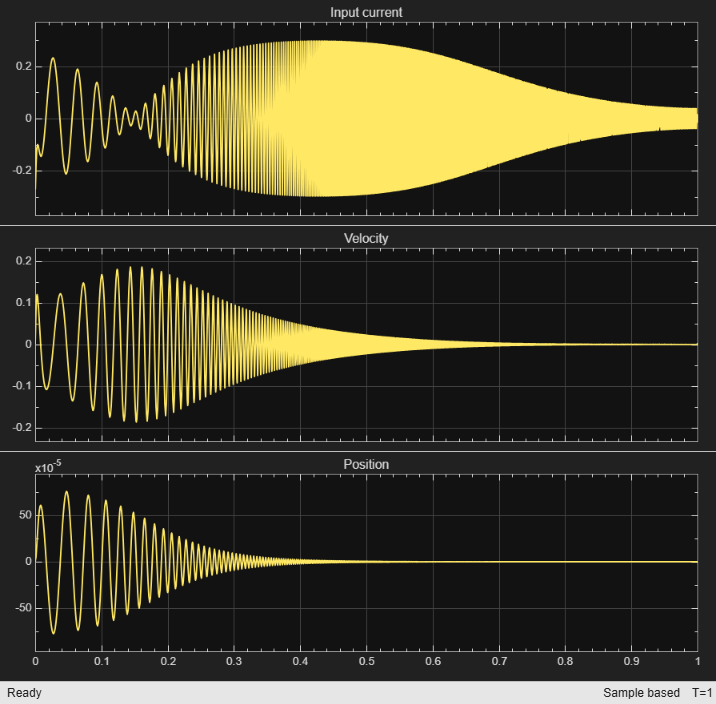
Simscape™ allows mixing electrical and mechanical elements, so the loudspeaker model can be simulated without any physical domain conversions. The electrical domain (voice coil resistance and inductance) is coupled to the mechanical domain (moving mass, damper, and spring) through a translational electromechanical converter with a force factor .
model = 'LinearMixedDomain';
open_system(model);
sim(model,1);
close_system(model,0)
Adding DSP to a Physical Model
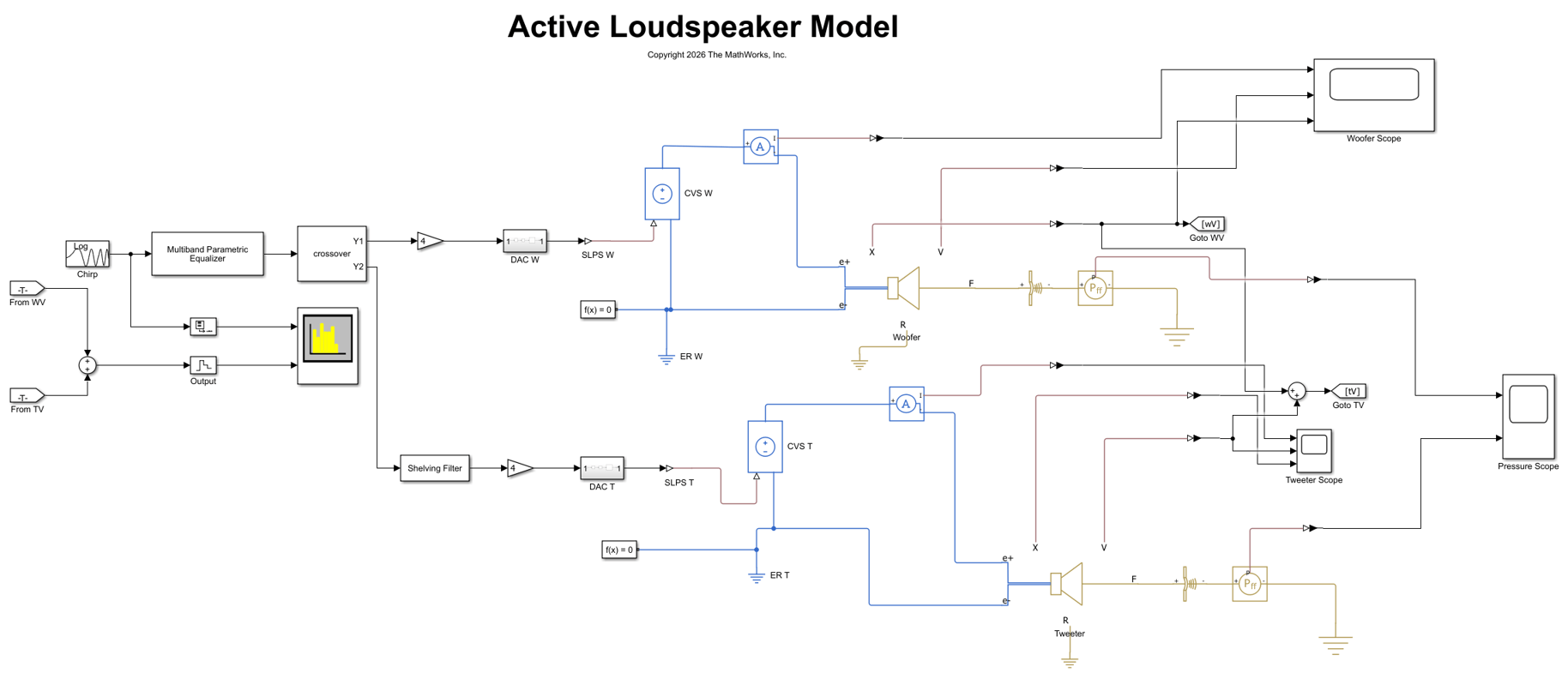
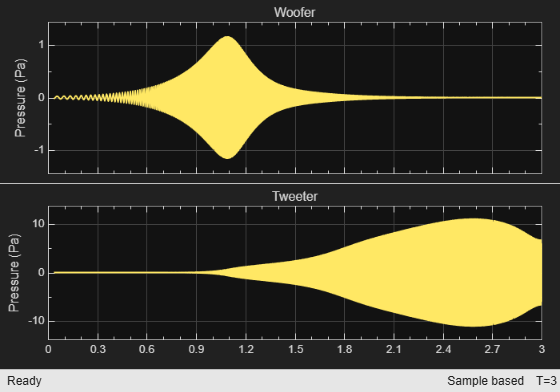
In addition to combining two physical domains in one simulation, digital signal processing algorithms can be included. The following model represents an active loudspeaker with a woofer and a tweeter. The crossover, parametric EQ and shelving filters are implemented in the digital domain, followed by an optimized power amplifier for each driver.
In this model, the physical loudspeaker drivers are implemented using the Moving Coil Speaker block from the Simscape Acoustics library. This block encapsulates the electrical (voice coil resistance and inductance), electromechanical coupling (force factor ), and mechanical (moving mass, compliance, damping) elements in a single component. The front sides of the drivers are connected to a radiation impedance and a block that calculates the far field radiation from its velocity.
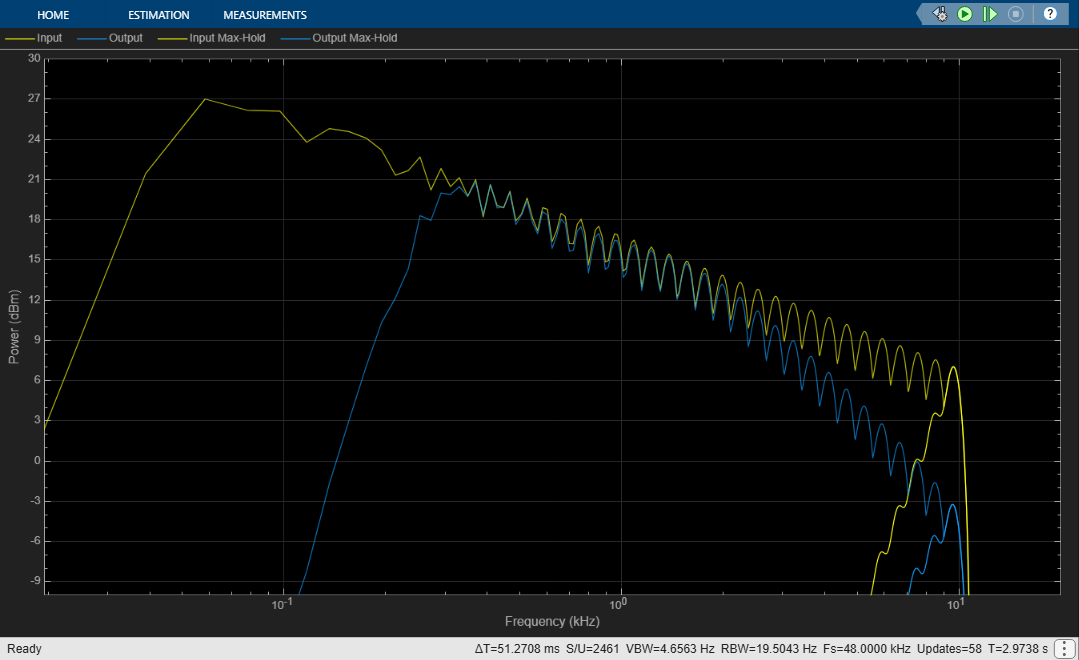
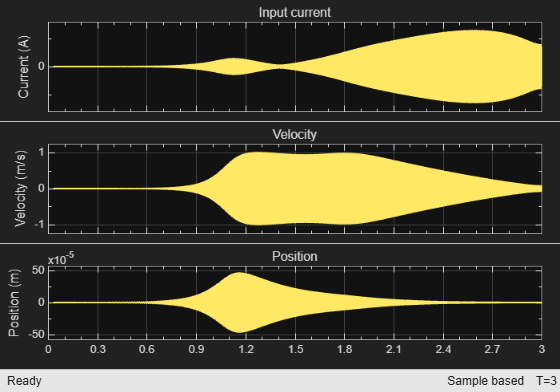
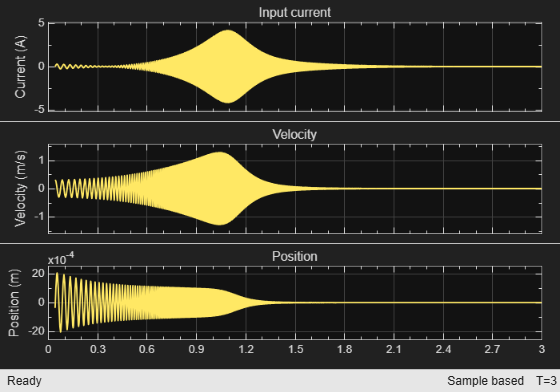
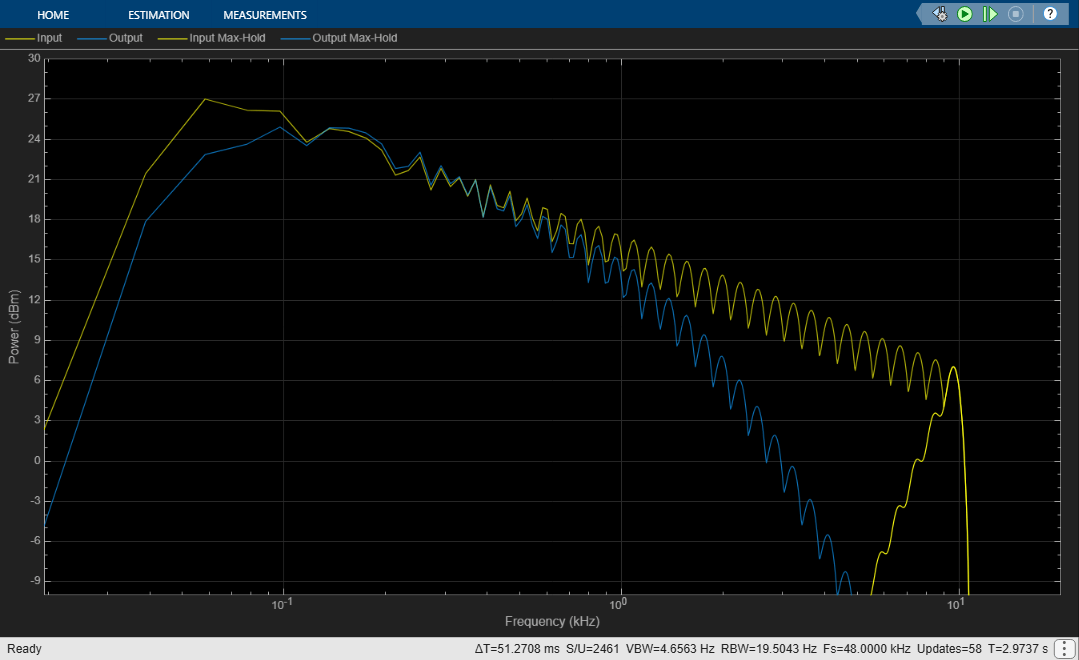
The output of each driver is measured separately, and the combined output is compared to the log-chirp input in the frequency domain.
model = 'MixedModelingAcoustics';
open_system(model);
sim(model,3);
close_system(model,0)
Modeling Nonlinear Elements
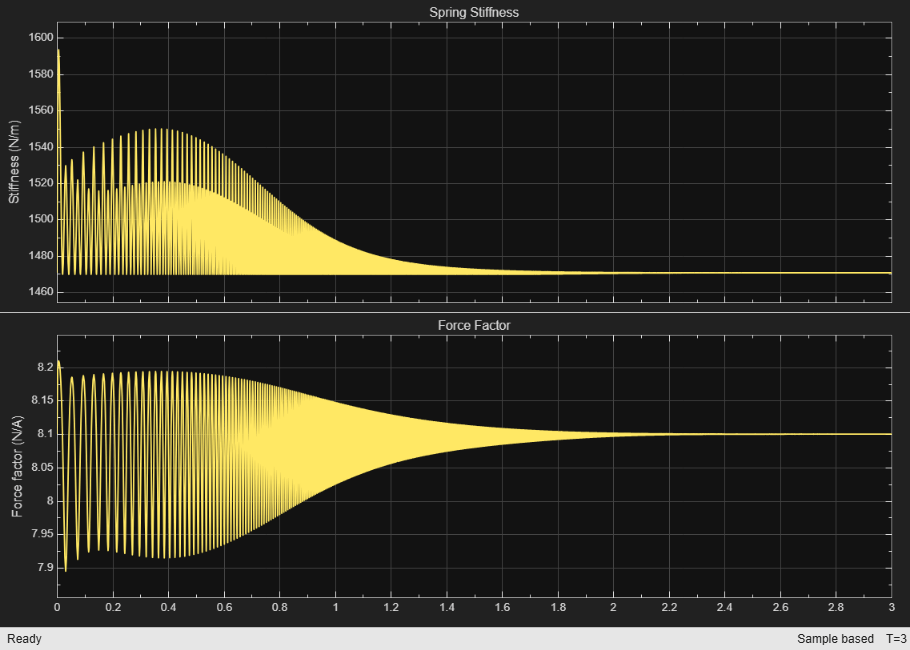
Several loudspeaker elements are nonlinear. For example, the voice coil force factor and inductance vary with its position in the magnet. Furthermore, the suspension spring rate changes at the extremities of its displacement range.
The Moving Coil Speaker block in the Simscape Acoustics library supports nonlinear modeling of the force factor () and stiffness ( ) as polynomial functions of displacement:


These nonlinear options can be enabled directly on the block, replacing the need for custom Simscape components.
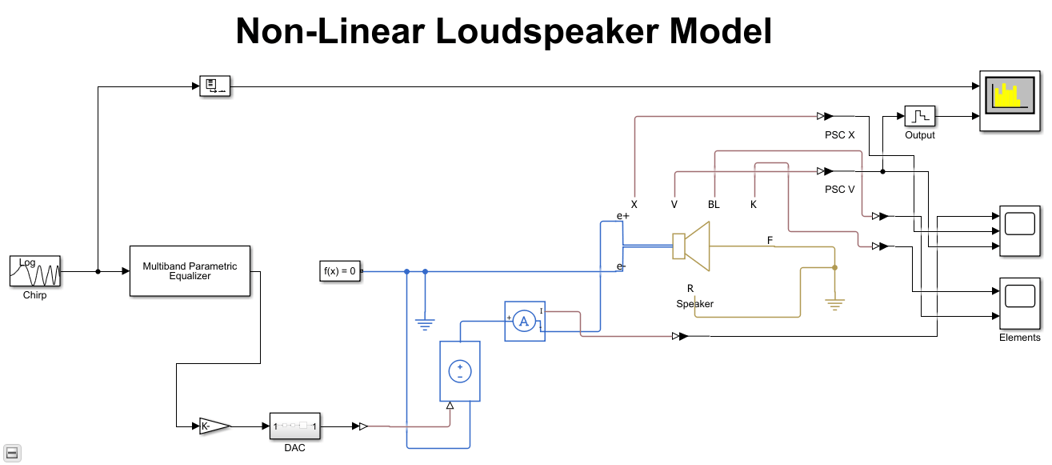
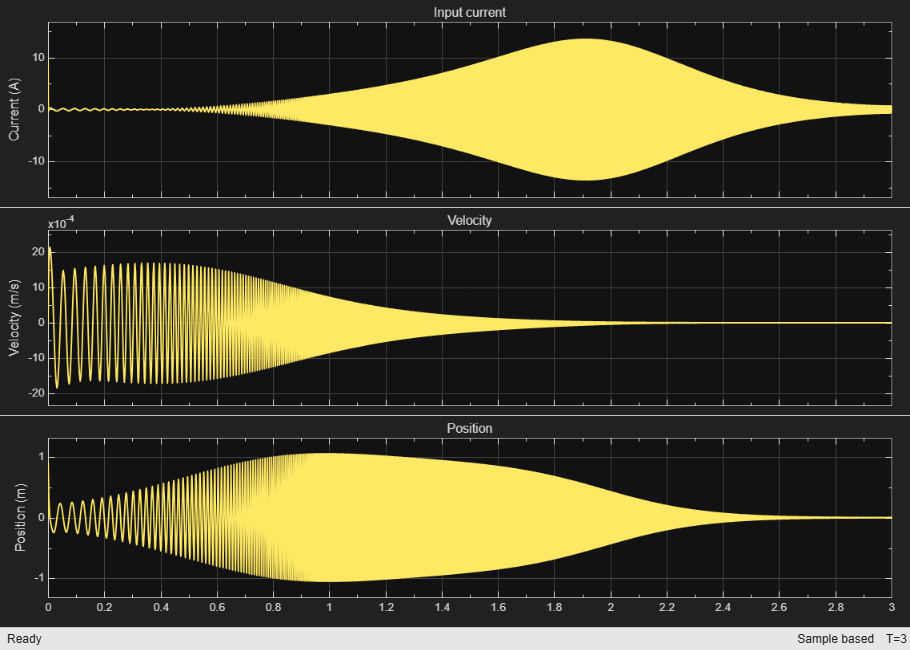
Run the model that implements the woofer driver with nonlinear force factor and stiffness enabled on the Moving Coil Speaker block.
model = 'NonLinearAcoustics';
open_system(model);
sim(model,3);
close_system(model,0)
Definitions
input voltage
input current
voice coil inductance
voice coil resistance
force factor
 force applied to the diaphragm
diaphragm velocity
 diaphragm displacement
moving mass
mechanical loss
suspension compliance
acoustical impedance

