High Resolution Filter-Bank-Based Power Spectrum Estimation
R2026bThis example demonstrates how to perform high-resolution spectral analysis using an efficient polyphase filter bank, commonly referred to as a Channelizer. Filter-bank-based methods offer superior frequency resolution and accuracy compared to traditional approaches such as the Welch method, especially when analyzing signals with varying frequency characteristics.
Key Concepts
Polyphase Filter Bank (Channelizer): A computationally efficient structure that splits a broadband signal into multiple subbands using polyphase FIR filters and FFT-based processing.
High-Resolution Spectral Estimation : Achieved by applying filter banks with a large number of phases, enabling fine frequency discrimination.
Adaptive Resolution : Different frequency bands can be analyzed with varying resolutions, optimizing computational efficiency.
Open the Model
mdl = 'HighResolutionSpectrumEstimationExample';
open_system(mdl);
Exploring the Model
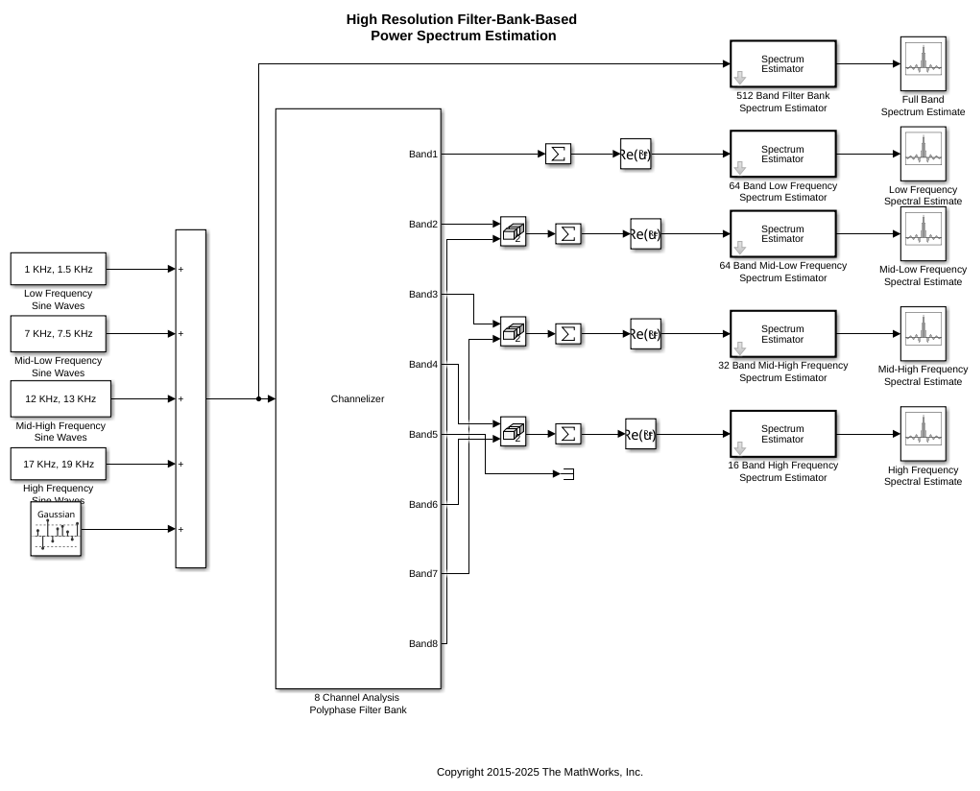
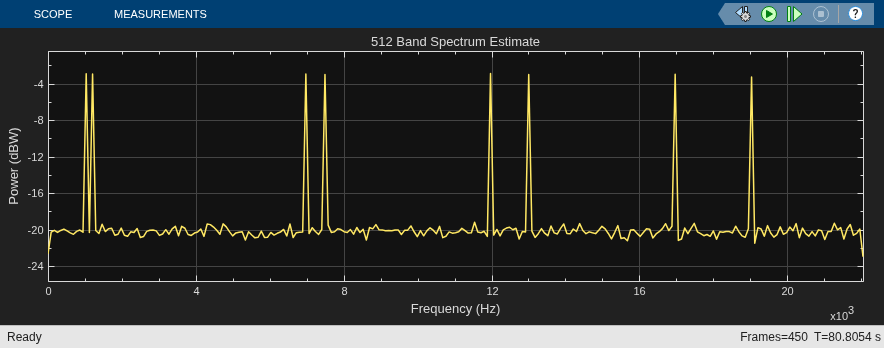
The model compares full band and subband spectral estimators. The full band estimator requires a 512-phase polyphase FIR filter and a 512-point FFT in order to compute the spectral estimate. The sinusoid frequencies in each subband are spaced further apart as the frequency increases. The idea is to setup a case in which higher frequency resolution is required at the low frequency band and lower resolution is required at higher frequency bands.
Full Band Estimator
Uses a 512-phase polyphase FIR filter and a 512-point FFT.
Provides uniform high resolution across the entire frequency range.
Computationally expensive for broadband signals.
Subband Approach
Starts with an 8-phase polyphase FIR filter and an 8-point FFT to divide the broadband signal into 8 subbands.
Each subband is analyzed with a filter bank tailored to its frequency components:
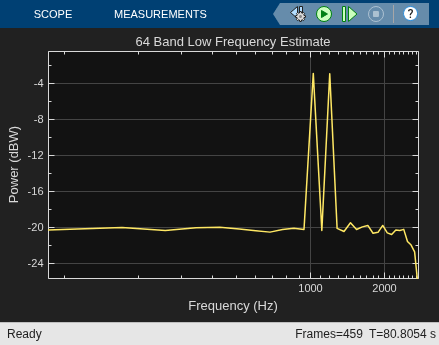
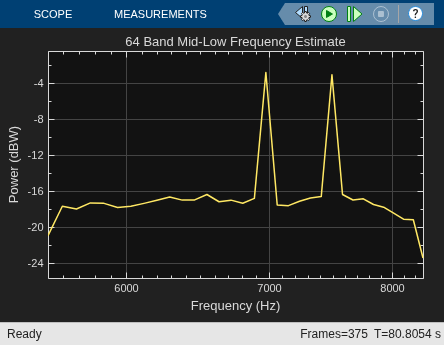
Low-frequency subband: Requires high resolution -> uses a 64-band filter bank (64-phase FIR + 64-point FFT).
Mid-low frequency subband: Same implementation as low-frequency.
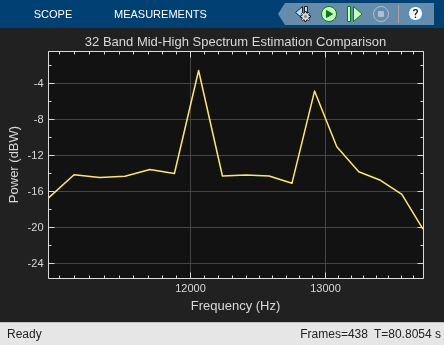
Mid-high frequency subband: Sinusoids are spaced farther apart -> uses a 32-band filter bank.
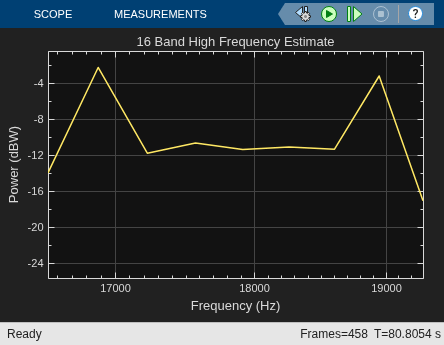
High-frequency subband: Requires the least resolution -> uses a 16-band filter bank.
This hierarchical approach significantly reduces computational complexity while maintaining the required resolution where it matter most.
Why Use Filter Banks Instead of Welch
Welch Method : Relies on windowing and averaging, which can smear spectral peaks and reduce resolution.
Filter Bank Method : Provides sharper spectral estimates and better control over resolution by adjusting the number of phases and FFT size.
For a detailed comparison between filter bank and Welch-based spectral estimators, see, High Resolution Spectral Analysis in MATLAB.
Simulate the Model
For the mid-high frequency band, the Sinusoids are spaced further apart. Hence, a 32 band filter bank estimator is used. For the high-frequency band, we use a 16 band filter bank estimator.
sim(mdl);
References
Harris, f. j. Multirate Signal Processing for Communications Systems, Prentice Hall PTR, 2004.

