Interleave
R2026bConvert separate Cb and Cr components into interleaved CbCr frame
Interleave block
To add a block to a model, double-click the canvas and start typing the block name. Then, select the block from the list.
Libraries:
SoC Blockset for AMD /
Zynq 7000 /
PicoZed
SoC Blockset for AMD /
Zynq 7000 /
ZC702
SoC Blockset for AMD /
Zynq 7000 /
ZC706
SoC Blockset for AMD /
Zynq 7000 /
ZedBoard
SoC Blockset for AMD /
MPSoC /
ZCU102
SoC Blockset for AMD /
MPSoC /
ZCU106
Description
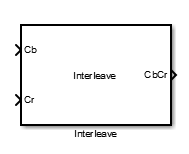
The Interleave block accepts separate Cb and Cr frame components. The output is a frame consisting of interleaved Cb and Cr data. Use this block to prepare for conversion from frames to pixel-streaming when targeting YCbCr 4:2:2 format on the FPGA with an HDMI FMC card.
Note
This block does not support HDL code generation, and you cannot use this block inside the FPGA user logic.
The FPGA data path for YCbCr 4:2:2 format consists of a Y component and a time-interleaved CbCr component. The pixel-streaming subsystem targeted for the user logic on the FPGA must have these two input and output ports. Captured YCbCr video data from board comes into Simulink® as three component frames. The horizontal size of the Cb and Cr frames is half the size of the Y component. For pixel-streaming design, recreate an interleaved CbCr component by combining the Cb and Cr frames before converting to a pixel stream. When you convert the frame to pixel streams, use dummy data (duplicate the interleaved CbCr frame) for the third component. See the Frame to Pixels for YCbCr 4:2:2 block in the YCbCr 4:2:2 HDL Pixel-Streaming Algorithm template, and the example models.
Examples
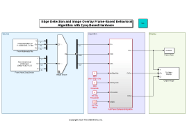
Developing Vision Algorithms for Zynq-Based Hardware
Design and deploy a streaming video algorithm to the FPGA on a Zynq® device.
Ports
Input
Output
Version History
Introduced in R2016a

