DBPSK Modulator Baseband
R2026bModulate using differential binary phase shift keying method
DBPSK Modulator Baseband block

To add a block to a model, double-click the canvas and start typing the block name. Then, select the block from the list.
Libraries:
Communications Toolbox /
Modulation /
Digital Baseband Modulation /
PM
Description
The DBPSK Modulator Baseband block modulates signals using the differential binary phase shift keying (DBPSK) method. The output is a baseband representation of the modulated signal. For more information, see Algorithms.
Examples
Pass a DBPSK-modulated signal through an additive white Gaussian noise (AWGN) channel. Demodulate the received signal and calculate the symbol error rate (SER).
The cm_dbpsk_mod_demod model DBPSK-modulates a random data signal, applies AWGN, and then DBPSK-demodulates the signal. An Error Rate Calculation block computes the SER. In the Error Rate Calculation block, a setting of 1 for the Computation delay parameter accounts for a 1-bit transient introduced by the differential modulation.
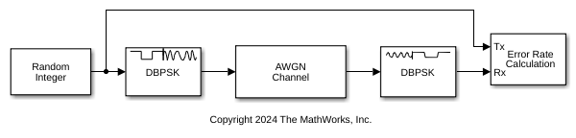
Display the computed SER with Es/N0 set to 10.
With EsN0 set to 10, SER = 0.000000
Ports
Input
Output
Parameters
Block Characteristics
Data Types |
|
Multidimensional Signals |
|
Variable-Size Signals |
|
Programmatic Use: Add Block
To add the block programmatically, use the add_block function with one of these library block paths as the source.
"commdigbbndpm3/DBPSK Modulator Baseband"
Example: add_block("commdigbbndpm3/DBPSK Modulator Baseband","myModel/myBlock",MakeNameUnique="on")
More About
Algorithms
For a phase rotation of ϕ radians, the DBPSK modulation method follows these rules:
If the first input bit is 0 or 1, respectively, then the first modulated symbol is e(jϕ) or –e(jϕ), respectively.
If a successive input bit is 0 or 1, respectively, then the modulated symbol is the previous modulated symbol multiplied by e(jϕ) or –e(jϕ), respectively.
ϕ is the Phase rotation (rad) parameter value.
Extended Capabilities
Version History
Introduced before R2006a

