isproper
R2026bDetermine if dynamic system model is proper
Syntax
B = isproper(sys)

B = isproper(sys,"elem")

[B,sysr,info] = isproper(sys)

[B,sysr,info] = isproper(sys,info)
Description
B = isproper(sys) returns
a logical value of 1 (true)
if the dynamic system model sys is proper and a
logical value of 0 (false) otherwise.
A proper model has relative degree ≤ 0 and is causal. SISO transfer functions and
zero-pole-gain models are proper if the degree of their numerator is less than or equal
to the degree of their denominator (in other words, if they have at least as many poles
as zeros). MIMO transfer functions are proper if all their SISO entries are proper.
Regular state-space models (state-space models having no E matrix)
are always proper. A descriptor state-space model that has an invertible
E matrix is always proper. A descriptor state-space model having
a singular (non-invertible) E matrix is proper if the model has at
least as many poles as zeros.
If sys is a model array, then B is 1 if
all models in the array are proper.
B = isproper(sys,"elem") checks each model in a model array
sys and returns a logical array of the same size as
sys. The logical array indicates which models in
sys are proper. The "elem" argument has no
effect if dsys is a single model instead of a model array.
[B,sysr,info] = isproper(sys) takes a single
model sys and also returns the equivalent model
sysr. If sys is not proper, sysr =
sys. If sys is a proper descriptor state-space model
with a non-invertible E matrix, sysr has fewer
states (reduced order) and a non-singular E matrix. The
info structure contains projection matrices that reflect the
transformation. For more information on projector matrices, see Spectral Projector Matrices. For more
information on info, see dss2ss
and sminreal.
[B,sysr,info] = isproper(sys,info) also takes an
info matrix or structure containing information to propagate
through the transformation. The info structure returned as last
output contains updated initial conditions, and updated projection matrices that reflect
the transformation.
Examples
Create a SISO continuous-time transfer function, .
H1 = tf([1 0],1);
Check whether H1 is proper.
B1 = isproper(H1)
B1 = logical
   0
SISO transfer functions are proper if the degree of their numerator is less than or equal to the degree of their denominator. That is, if the transfer function has at least as many poles as zeros. Since H1 has one zero and no poles, the isproper command returns 0.
Now create a transfer function with one pole and one zero, .
H2 = tf([1 0],[1 1]);
Check whether H2 is proper.
B2 = isproper(H2)
B2 = logical
   1
Since H2 has equal number of poles and zeros, isproper returns 1.
Combining state-space models sometimes yields results that include more states than necessary. Use isproper to compute an equivalent lower-order model.
H1 = ss(tf([1 1],[1 2 5]));
H2 = ss(tf([1 7],[1]));
H = H1*H2;
size(H)
State-space model with 1 outputs, 1 inputs, and 4 states.
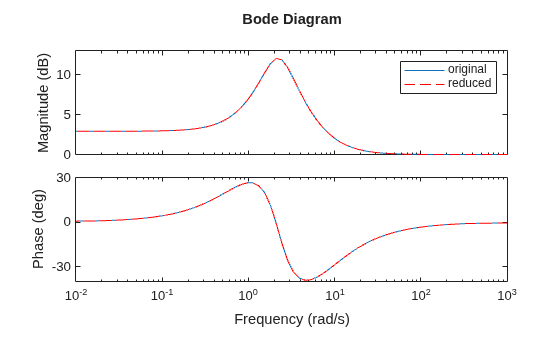
H is proper and reducible. isproper returns the reduced model.
[isprop,Hr] = isproper(H);
size(Hr)
State-space model with 1 outputs, 1 inputs, and 2 states.
H and Hr are equivalent, as a Bode plot demonstrates.
bodeplot(H,Hr,'r--')
legend('original','reduced')
References
[1] Varga, Andràs. "Computation of irreducible generalized state-space realizations." Kybernetika 26.2 (1990): 89-106.
Version History
Introduced before R2006a

