Physics-Informed Machine Learning
R2026bUse Deep Learning Toolbox™ for physics-informed machine learning (PIML) and physics-informed neural networks (PINNs).
Physics-informed machine learning (PIML) and physics-informed neural networks refer to machine learning and deep learning concepts where you can integrate laws and principles of physical systems into your machine learning models. Integrating these concepts can improve accuracy and robustness in these models and can help ensure that the model predictions also follow such laws and principles. For example, you can train a neural network that models heat transfer using a loss function that incorporates laws of thermodynamics.
Functions
Topics
- Train Transolver Neural Network for 3-D Electrostatic Field Prediction
This example shows how to train a Transolver neural network to predict electric potential fields for a 3-D electrostatics problem. (Since R2026b)
- Solve PDE Using Fourier Neural Operator
This example shows how to train a Fourier neural operator (FNO) neural network that outputs the solution of a partial differential equation (PDE).
- Solve PDE Using Physics-Informed Neural Network
This example shows how to train a physics-informed neural network (PINN) to predict the solutions of a partial differential equation (PDE).
- Solve ODE Using Physics-Informed Neural Network
This example shows how to train a physics-informed neural network (PINN) to predict the solutions of an ordinary differential equation (ODE).
- Train Latent ODE Network with Irregularly Sampled Time-Series Data
This example shows how to train a latent ordinary differential equation (ODE) autoencoder with time-series data that is sampled at irregular time intervals.
- Dynamical System Modeling Using Neural ODE
This example shows how to train a neural network with neural ordinary differential equations (ODEs) to learn the dynamics of a physical system.
- Train Neural ODE Network with Control Input
This example shows how to train a neural ODE that models a swinging pendulum with torque input. (Since R2026a)
- Solve Inverse Problem for PDE Using Physics-Informed Neural Network
This example shows how to solve an inverse problem using a physics-informed neural network (PINN). (Since R2025a)
- Solve Poisson Equation on Unit Disk Using Physics-Informed Neural Networks (Partial Differential Equation Toolbox)
Solve a Poisson's equation with Dirichlet boundary conditions using a physics-informed neural network (PINN).
- Train Complex-Valued Physics-Informed Neural Network
This example shows how to train a complex-valued, physics-informed neural network to simulate the behavior of electrons inside a simplified 2-D condensed matter physics system. (Since R2026b)
Related Information
Featured Examples
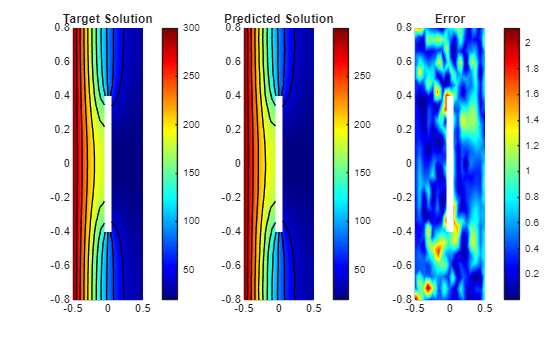
Solve Heat Equation Using Graph Neural Network
Solve a heat equation with using a graph neural network (GNN).
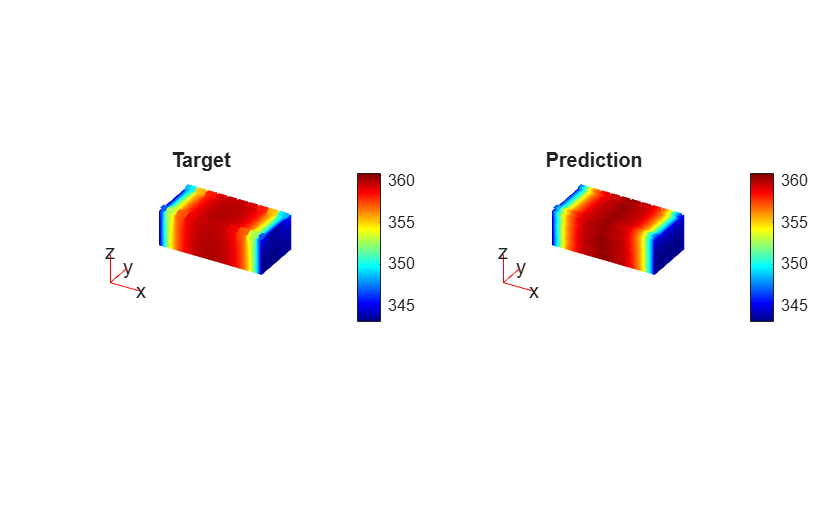
3-D Battery Module Cooling Analysis Using Fourier Neural Operator
Model three-dimensional heat diffusion in a battery module using a Fourier neural operator (FNO) neural network.

