numRegions
R2026bNumber of regions in alpha shape
Syntax
Description
N = numRegions( returns the number
of distinct regions that make up the alpha shape. For an alpha radius of
shp)Inf, the alpha shape is the convex hull, and the number of
regions is one. As the value of the alpha radius decreases the shape can break into
separate regions, depending on the point set.
Examples
Create and plot a set of 2-D points.
th = (pi/12:pi/12:2*pi)';
x1 = [reshape(cos(th)*(1:5), ...
      numel(cos(th)*(1:5)),1);
      0];
y1 = [reshape(sin(th)*(1:5), ...
      numel(sin(th)*(1:5)),1);
      0];
x = [x1;x1+15;];
y = [y1;y1];
plot(x,y,".")
axis equal
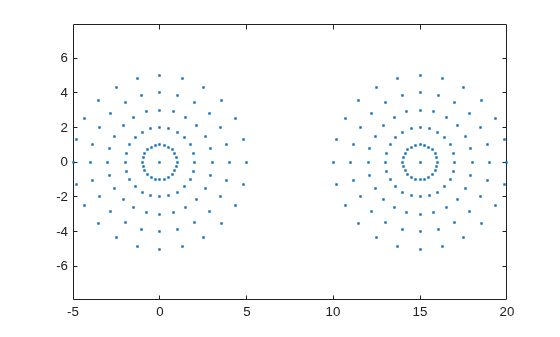
Create an alpha shape using an alpha radius of 7 and query the number of distinct regions in the shape.
shp = alphaShape(x,y,7);
nregions = numRegions(shp)
nregions =
1
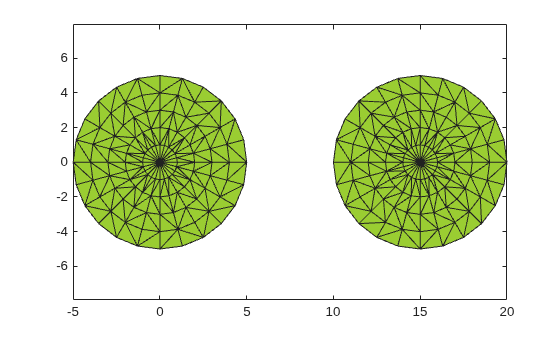
Use a smaller alpha radius of 2.5 to better capture the boundary and then retrieve the new number of distinct regions.
shp.Alpha = 2.5;
nregions = numRegions(shp)
nregions =
2
Plot the alpha shape to check the boundary quality.
plot(shp)
Input Arguments
Version History
Introduced in R2014b

