Reluctance Force Actuator
R2026bMagnetomotive device based on reluctance force
Reluctance Force Actuator block

To add a block to a model, double-click the canvas and start typing the block name. Then, select the block from the list.
Libraries:
Simscape /
Foundation Library /
Magnetic /
Magnetic Elements
Description
The Reluctance Force Actuator block models a generic magnetomotive device based on reluctance force.
The block uses the equations
where:
F is the reluctance force.
Φ is the flux in the magnetic circuit.
is the reluctance.
x is the thickness of the section being modeled, or the length of air gap.
μ0 is the permeability constant.
μr is the relative permeability of the material.
A is the cross-sectional area of the section being modeled.
u is the velocity.
Connections N and S are magnetic conserving ports, and connections C and R are mechanical translational conserving ports. The magnetic force produced by the actuator acts to close the gap, therefore the resulting force is negative when it acts from C to R.
Variables
To set the priority and initial target values for the block variables prior to simulation, use the Initial Targets section in the block dialog box or Property Inspector. For more information, see Set Priority and Initial Target for Block Variables.
Nominal values provide a way to specify the expected magnitude of a variable in a model. Using system scaling based on nominal values increases the simulation robustness. Nominal values can come from different sources, one of which is the Nominal Values section in the block dialog box or Property Inspector. For more information, see Modify Nominal Values for a Block Variable.
Examples
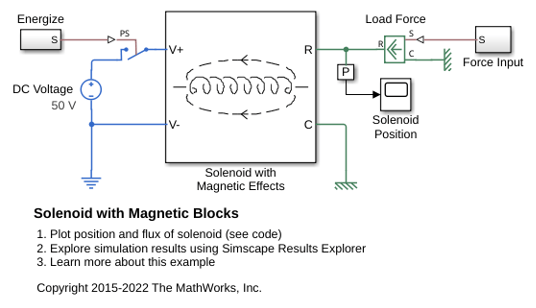
Solenoid with Magnetic Blocks
Model a solenoid with spring return. When unpowered, the spring pulls the plunger +5mm away from the center of the coil. Turning on the power supply at t=0.1 seconds pulls the plunger into the center of the coil. At t=0.3s, a 10N external load is added to the plunger.
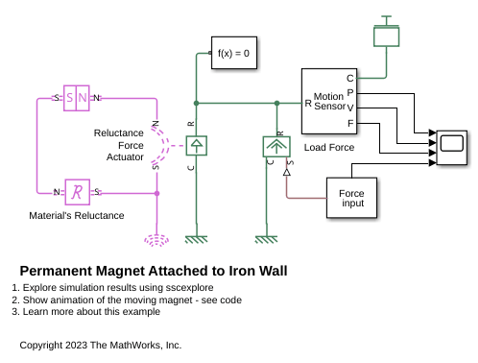
Permanent Magnet Attached to Iron Wall
Model the forces acting on a magnet that is attached to an iron wall. You can define the interaction between the magnetic and translational motion domains using a Permanent Magnet block and a Reluctance Force Actuator block.
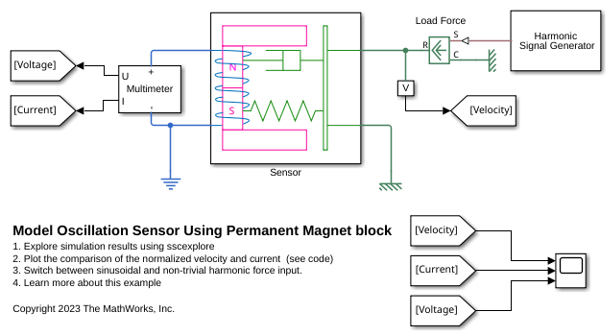
Model Oscillation Sensor Using Permanent Magnet Block
Model an oscillation sensor using the Permanent Magnet block. The sensor consists of a magnetic core with a permanent magnet that generates a magnetic field, a ferromagnetic plate attached to the core, and a conducting winding around the core.
Ports
Conserving
Parameters
Extended Capabilities
Version History
Introduced in R2010a

