Contenu principal

walkerDelta

R2026b

Create Walker-Delta constellation in satellite scenario

Since R2022a

Description

sat = walkerDelta(scenario,radius,inclination,totalSatellites,geometryPlanes,phasing) creates an array of satellites, sat, in satellite scenario scenario using the specified Walker-Delta constellation parameters. The constellation geometry is defined with respect to the celestial body specified by the CentralBody name‑value argument. The ascending nodes of the orbital planes are evenly spaced over 360 degrees.

For more information on Walker-Delta constellations, see Algorithms.

sat = walkerDelta(__,Name=Value) creates an array of satellites using one or more optional Name=Value arguments. Use this option with any of the input argument combinations in the previous syntax.

example

Examples

collapse all

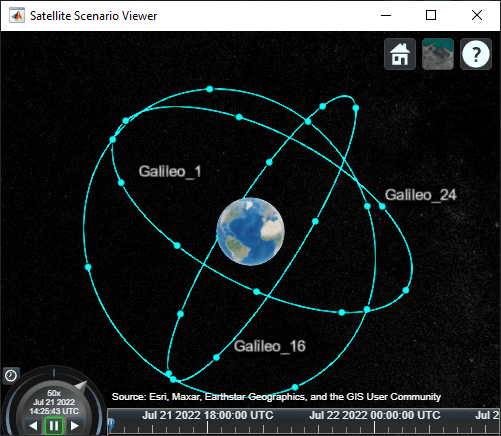
Model a Galileo constellation as a Walker-Delta constellation that contains 24 satellites in three planes inclined at 56 degrees (56:24/3/1) in a 29599.8 km orbit. Provide an initial argument of latitude offset of 15 degrees.

Create a default satellite scenario object.

sc = satelliteScenario;

Create Walker-Delta constellation that contains 24 satellites in three planes inclined at 56 degrees (56:24/3/1) in a 29599.8 kilometer orbit.

sat = walkerDelta(sc, 29599.8e3, 56, 24, 3, 1, ...
       ArgumentOfLatitude=15, Name="Galileo");

Visualize the scenario using the Satellite Scenario Viewer. Hide the orbits and labels of the satellites by setting the ShowDetails name-value argument to false. Mouse over satellites to show their labels. Click a satellite to reveal its label, orbit, and any other hidden graphics. Click the satellite again to dismiss them.

satelliteScenarioViewer(sc, ShowDetails=false);
Input Arguments

collapse all

Satellite scenario, specified as a satelliteScenario object.

Orbital radius, specified as a scalar, in meters.

Data Types: double

Inclination, specified as a scalar, in degrees.

Data Types: double

Total number of satellites, specified as a scalar positive integer.

Data Types: double

Number of equally spaced geometry planes, specified as a scalar positive integer.

Data Types: double

Phasing between satellites in adjacent planes, specified as a scalar integer greater than or equal to 0 and less than the value of geometryPlanes. The change in true anomaly for equivalent satellites in neighboring planes is calculated as:

(phasing*360/totalSatellites).

Data Types: double

Name-Value Arguments

collapse all

Specify optional pairs of arguments as Name1=Value1,...,NameN=ValueN, where Name is the argument name and Value is the corresponding value. Name-value arguments must appear after other arguments, but the order of the pairs does not matter.

Example: sat = walkerDelta(sc,29599.8e3,56, 24,3,1,Name="Galileo") creates an array of satellites named Galileo.

Celestial body with respect to which the Walker‑Delta constellation is created, specified as "Earth" or "Moon".

Right ascension of ascending node, specified as a scalar value from 0 to 360. RAAN is the angle in the ICRF x-y plane from the x-axis to the location of the ascending node, point at which the satellite crosses the ICRF x-y plane from below to above, in degrees. The function uses this value as the starting point for distribution of the satellites along the ICRF x-y plane.

Data Types: double

Argument of latitude, specified as a scalar value from 0 to 360. ArgumentOfLatitude is the angle between the ascending node and the body. The function uses this value as the starting point for distribution of satellites along the first orbital track.

Data Types: double

Constellation name, specified as a scalar.

Individual satellite names within the constellation use the constellation name appended with increasing whole numbers starting with 1, for example, Name_1, Name_2, and so forth.

Data Types: char | string

Name of orbit propagator used for propagating satellite position and velocity, specified as one of these values:

  • "two-body-keplerian" — Two-Body-Keplerian orbit propagator based on the relative two-body model that assumes a spherical gravity field for the central body and neglects third body effects and other environmental perturbations. It is considered the least accurate.

  • "sgp4" — Simplified General Perturbations-4 orbit propagator.

  • "sdp4" — Simplified Deep-Space Perturbations-4 orbit propagator.

  • "numerical" — Numerical orbit propagator that integrates the equations of motion using a configurable force model specified by numerical propagator options.

Dependencies

If CentralBody equals "Moon", OrbitPropagator must equal "two-body-keplerian" or "numerical".

Data Types: string | char

Output Arguments

collapse all

Satellite in scenario, returned as an array of Satellite objects.

Algorithms

Walker-Delta constellations are a common solution for maximizing geometric coverage over a celestial body while minimizing the number of satellites required to perform the mission. Walker-Delta constellation patterns use the notation:

I:T/P/F.
where:

  • I — Orbital inclination

  • T — Total number of satellites, which must be divisible by F

  • P — Number of equally spaced geometric planes

  • F — Phasing between satellites in adjacent planes

To define the radial height of the circular orbit (with respect to the central body), the function also requires a radius r.

In addition:

  • The ascending nodes of the orbital planes of a Walker-Delta constellation are uniformly distributed at intervals of 360/P deg around the ICRF x-y plane.

  • The number of satellites per plane, satellitesPerPlane, is defined as

    satellitesPerPlane=T/P.

    The satellites in each orbital plane are distributed at intervals of 360/satellitesPerPlane deg. F represents the interplane phasing, the number of empty slots between the first satellites in each orbital plane.

Note

Walker-Delta constellations differ from Walker-Star constellations. For Walker-Delta constellations, the function distributes ascending nodes of the orbital planes across 360 degrees. For Walker-Star constellations, the function distributes ascending nodes across 180 degrees.

Version History

Introduced in R2022a

expand all