Ported Speaker Enclosure
R2026bPorted Speaker Enclosure block

To add a block to a model, double-click the canvas and start typing the block name. Then, select the block from the list.
Libraries:
Simscape Acoustics /
Applications /
Cavities and Enclosures
Description
Add-On Required: This feature requires the Simscape Acoustics add-on.
The Ported Speaker Enclosure block models a speaker enclosure with one, two, or three port tubes. The block assumes the dimensions of the enclosure are smaller than the acoustic wavelength at any frequency included in the analysis.
The model implements an equivalent circuit of an Acoustic Inertance block, which models the air mass at the rear side of the diaphragm, an Acoustic Compliance block, which models the air volume of the enclosure, and Acoustic Inertance and Cylindrical Tube With Thermoviscous Losses Using Foster Network blocks for each port. Each port connects internally to an Acoustic Reference block. The figure shows the equivalent circuit for an enclosure with two port tubes.
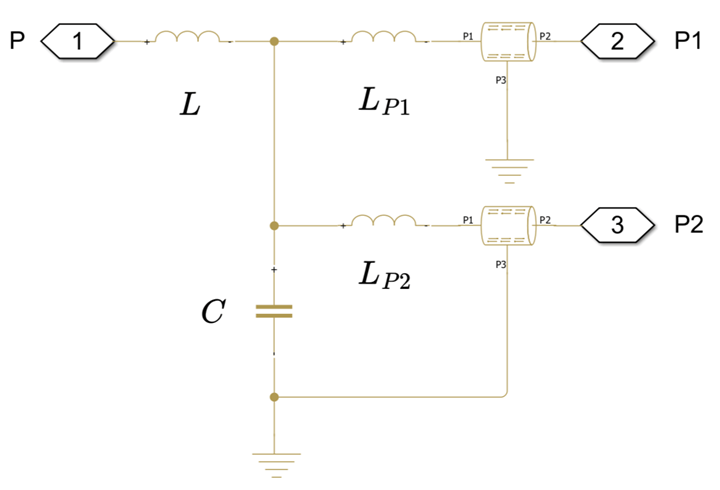
The compliance value of the block is
where:
V0 is the physical volume of the enclosure.
γ is the ratio of specific heats of the medium.
P0 is the ambient pressure of the medium.
The inertance value of the air mass behind the diaphragm is
where:
ρ is the density of the medium.
r is the radius of the speaker diaphragm.
A is the cross sectional area of the speaker diaphragm.
The inertance value of the air mass at each port entrance is
where rP is the radius of the port.
The Number of tube segments parameter sets the Number of differential tube lengths parameter of the internal Cylindrical Tube With Thermoviscous Losses Using Foster Network block in each port. The Tube length and Tube radius parameters of each internal Cylindrical Tube With Thermoviscous Losses Using Foster Network block are set by the corresponding port length and port radius parameters in the Ported Speaker Enclosure block.
Examples
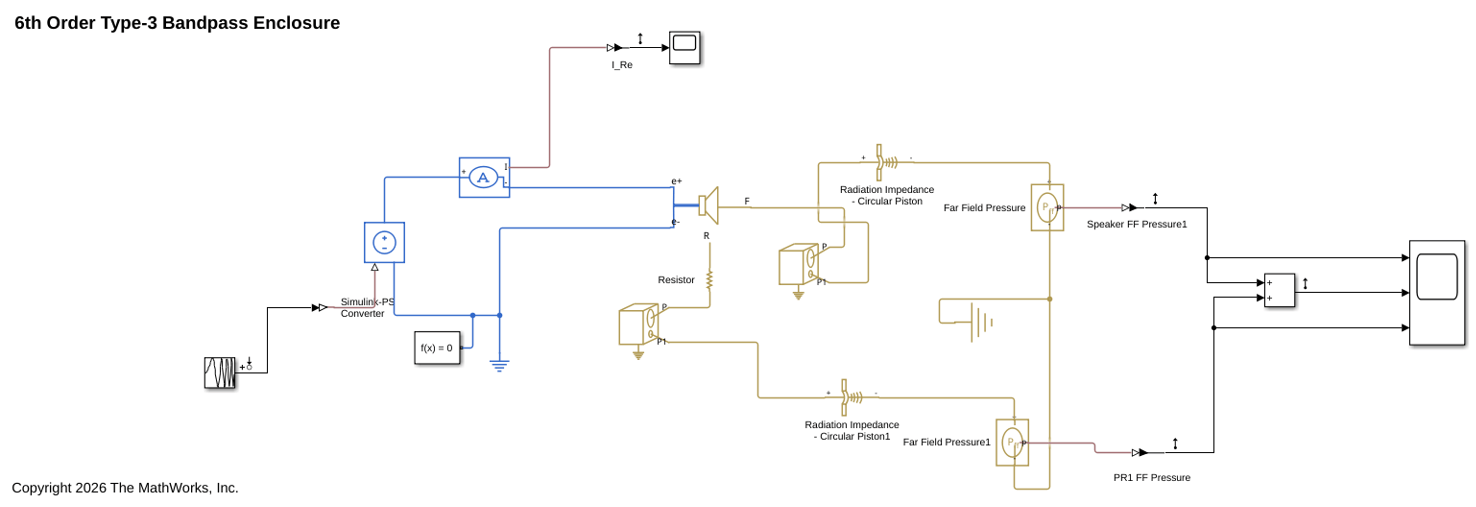
Loudspeaker Enclosure Modeling with Simscape Acoustics
Simulate different types of loudspeakers using Simscape™ Acoustics.
Ports
Conserving
Parameters
Version History
Introduced in R2026b

