dpcmenco
R2026bEncode using differential pulse code modulation
Syntax
Description
Examples
Use DPCM encoding and decoding to quantize the difference between the value of the current signal sample and the value of the previous sample. For this example, you use a predictor . Then, encode a sawtooth signal, decode it, plot both the original and the decoded signals, and compute the mean square error between the original and decoded signals.
partition = [-1:.1:.9];
codebook = [-1:.1:1];
predictor = [0 1];      % y(k)=x(k-1)
t = [0:pi/50:2*pi];     % Time samples
x = sawtooth(3*t);      % Original signal
Quantize x using DPCM encoding.
encodedx = dpcmenco(x,codebook,partition,predictor);
Recover x from the modulated signal by using DPCM decoding. Plot the original signal and the decoded signal. The solid line is the original signal, while the dashed line is the recovered signal.
decodedx = dpcmdeco(encodedx,codebook,predictor);
plot(t,x,t,decodedx,'-')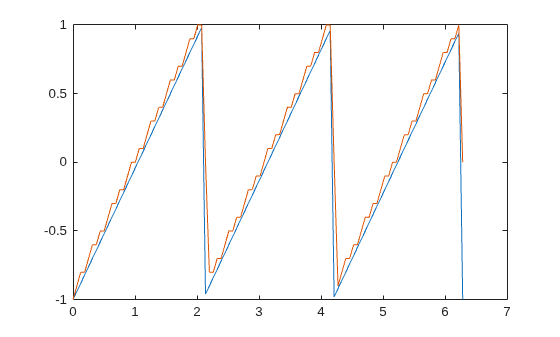
Compute the mean square error between the original signal and the decoded signal.
distor = sum((x-decodedx).^2)/length(x)
distor =
0.0327
To optimize a DPCM-encoded and -decoded sawtooth signal, use the dpcmopt function with the dpcmenco and dpcmdeco functions. Testing and selecting parameters for large signal sets with a fine quantization scheme can be tedious. One way to produce partition, codebook, and predictor parameters easily is to optimize them according to a set of training data. The training data should be typical of the kinds of signals to be quantized with dpcmenco.
This example uses the predictive order 1 as the desired order of the new optimized predictor. The dpcmopt function creates these optimized parameters, using the sawtooth signal x as training data. The example goes on to quantize the training data itself. In theory, the optimized parameters are suitable for quantizing other data that is similar to x. The mean square distortion for optimized DPCM is much less than the distortion with nonoptimized DPCM parameters.
Define variables for a sawtooth signal and initial DPCM parameters.
t = [0:pi/50:2*pi];
x = sawtooth(3*t);
partition = [-1:.1:.9];
codebook = [-1:.1:1];
predictor = [0 1];      % y(k)=x(k-1)
Optimize the partition, codebook, and predictor vectors by using the dpcmopt function and the initial codebook and order 1. Then generate DPCM encoded signals by using the initial and the optimized partition and codebook vectors.
[predictorOpt,codebookOpt,partitionOpt] = dpcmopt(x,1,codebook);
encodedx = dpcmenco(x,codebook,partition,predictor);
encodedxOpt = dpcmenco(x,codebookOpt,partitionOpt,predictorOpt);
Recover x from the modulated signal by using DPCM decoding. Compute the mean square error between the original signal and the decoded and optimized decoded signals.
decodedx = dpcmdeco(encodedx,codebook,predictor);
decodedxOpt = dpcmdeco(encodedxOpt,codebookOpt,predictorOpt);
distor = sum((x-decodedx).^2)/length(x);
distorOpt = sum((x-decodedxOpt).^2)/length(x);
Compare mean square distortions for quantization with the initial and optimized input arguments.
[distor, distorOpt]
ans = 1×2

    0.0327    0.0009
Input Arguments
Output Arguments
References
[1] Kondoz A. M., Digital Speech. Chichester, England: John Wiley & Sons, 1994.
Version History
Introduced before R2006a

