firlp2lp
R2026bTransform FIR Type I lowpass to FIR Type 1 lowpass with inverse bandwidth
Description
g = firlp2lp(b)b with zero-phase
response Hr(w) to a Type I lowpass FIR filter g with zero-phase
response [1 - Hr(π-w)].
When b is a narrowband filter, g will be a
wideband filter and vice versa. The passband and stopband ripples of
g will be equal to the stopband and passband ripples of
b, respectively.
tfiltObj = firlp2lp(pfiltObj)dsp.FIRFilter object. The function returns the target lowpass FIR
filter with an inverted bandwidth as a dsp.FIRFilter object. (since R2026a)
Examples
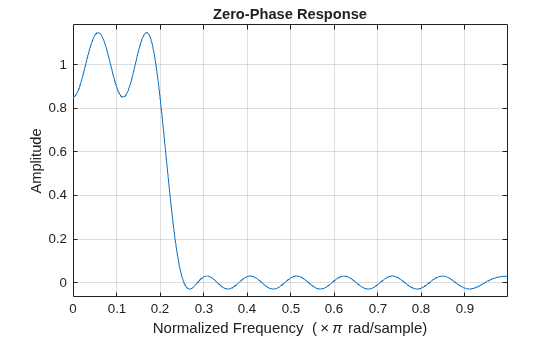
Create a narrowband lowpass filter to use as a prototype. Display its zero-phase response.
b = firgr(36,[0 0.2 0.25 1],[1 1 0 0],[1 5]);

zerophase(b)
Convert the prototype filter to a wideband lowpass filter. Add to the plot the zero-phase response of the new filter.
h = firlp2lp(b);

hold on
zerophase(h)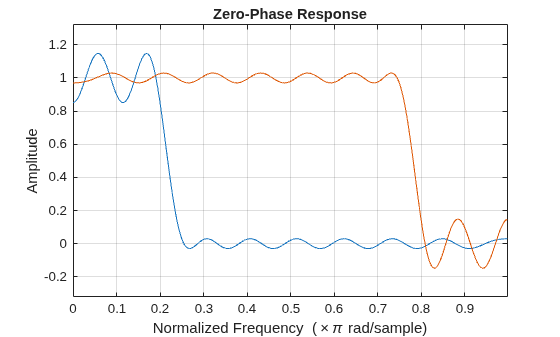
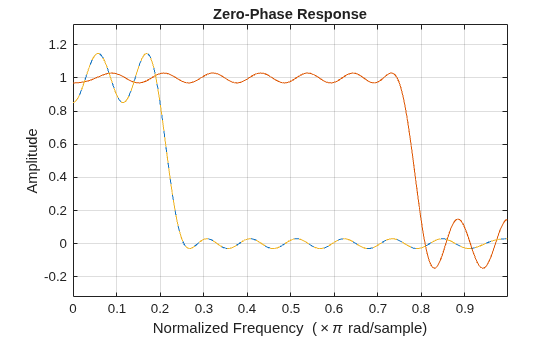
Convert the previous filter back to a narrowband lowpass filter. Add to the plot the zero-phase response of the new filter.
g = firlp2lp(h);

[gr,w] = zerophase(g);
plot(w/pi,gr,'--')
hold off
Since R2026a
Design and implement a lowpass FIR filter object using the designLowpassFIR function. Set the cutoff frequency to 0.7 rad/sample and the function designs a wideband lowpass FIR filter. Set the SystemObject argument to true to generate a dsp.FIRFilter object.
lpfirFilt = designLowpassFIR(FilterOrder=30,CutoffFrequency=0.7,Window="hann",...
        Datatype="single",SystemObject=true)
lpfirFilt =
  dsp.FIRFilter with properties:

            Structure: 'Direct form'
      NumeratorSource: 'Property'
            Numerator: [0 -1.4602e-04 -3.2707e-04 0.0024 -0.0039 6.8217e-18 0.0099 -0.0169 0.0078 0.0204 -0.0477 0.0390 0.0297 -0.1448 0.2547 0.7000 0.2547 -0.1448 0.0297 0.0390 -0.0477 0.0204 0.0078 -0.0169 0.0099 6.8217e-18 -0.0039 … ] (1×31 single)
    InitialConditions: 0

  Show all properties
Transform this filter to a narrowband lowpass FIR filter using the firlp2lp function.
tfirFilt = firlp2lp(lpfirFilt)
tfirFilt =
  dsp.FIRFilter with properties:

            Structure: 'Direct form'
      NumeratorSource: 'Property'
            Numerator: [0 1.4602e-04 -3.2707e-04 -0.0024 -0.0039 -6.8217e-18 0.0099 0.0169 0.0078 -0.0204 -0.0477 -0.0390 0.0297 0.1448 0.2547 0.3000 0.2547 0.1448 0.0297 -0.0390 -0.0477 -0.0204 0.0078 0.0169 0.0099 -6.8217e-18 -0.0039 … ] (1×30 single)
    InitialConditions: 0

  Show all properties
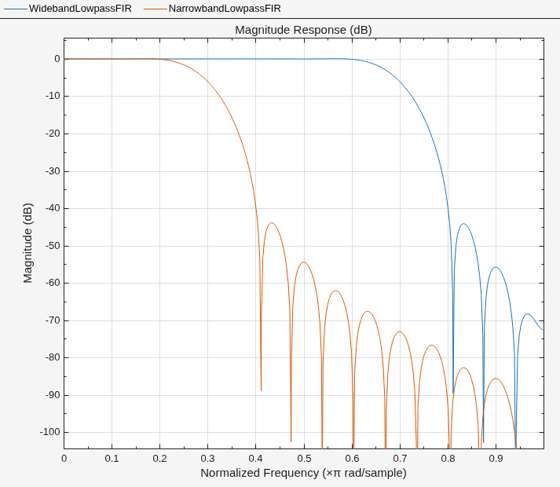
Visualize the magnitude response of the prototype filter and the transformed filter using the filter analyzer.
filterAnalyzer(lpfirFilt,tfirFilt,FilterNames=["WidebandLowpassFIR","NarrowbandLowpassFIR"])
Input Arguments
Output Arguments
References
[1] Mitra, Sanjit Kumar, and James F. Kaiser, eds. Handbook for Digital Signal Processing. New York: Wiley, 1993.

