Gaussian Beam Analysis
R2026bThe Gaussian‑beam method for antenna modeling and analysis is a highly efficient alternative to computationally intensive numerical methods such as physical optics (PO). By representing the electromagnetic field through closed‑form expressions for beam amplitude, phase, and wavefront curvature, this method enables you to quickly and accurately evaluate field propagation through large reflector systems as well as in phased arrays. This approach is particularly valuable at millimeter‑wave and sub‑millimeter frequencies, where reflector apertures and array sizes become electrically large and conventional PO surface integrations become prohibitively slow. The Gaussian‑beam method is therefore an effective tool for fast performance prediction, beam‑shaping analysis, and early‑stage design of high‑gain reflector antennas and phased arrays.
Use the objects and functions in this category to perform Gaussian-beam-based design and evaluation of parabolic reflector antennas and phased arrays commonly used in satellite, airborne, and terrestrial high-gain communication and radar systems.
Objects
reflectorCalculator | Create parabolic reflector antenna for Gaussian beam analysis (Since R2026a) |
phasedArrayCalculator | Create phased array for Gaussian beam analysis (Since R2026b) |
Functions
createAntenna | Create dual-reflector antenna for full-wave analysis (Since R2026a) |
createArray | Create conformal array from calculated array design parameters (Since R2026b) |
peakDirectivity | Calculate maximum directivity (Since R2026a) |
plot | Visualize antenna layout and plot directivity, beamwidth, and efficiency (Since R2026a) |
solve | Analyze antenna using Gaussian-beam method (Since R2026a) |
Featured Examples
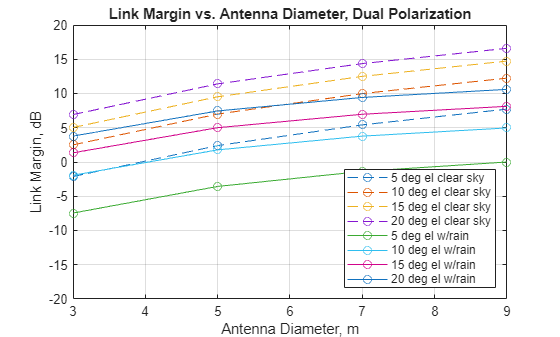
Antenna Size Analysis Using ITU-R P.618 Propagation Model
Select antenna diameter using the p618PropagationLosses function
in the toolbox.
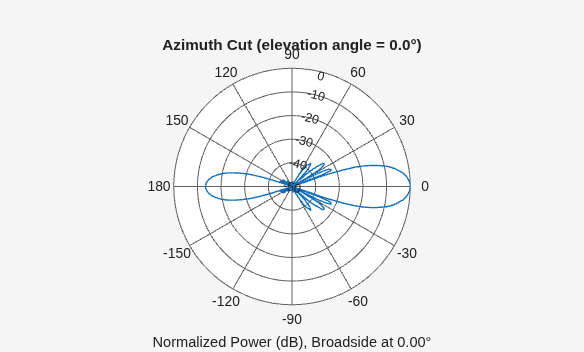
Using Antenna Toolbox with Phased Array Systems
You can use Antenna Toolbox™ antennas in your Phased Array System Toolbox™ simulation.

