La traduction de cette page n'est pas à jour. Cliquez ici pour voir la dernière version en anglais.
Machine Learning dans Simulink
R2026aImplémentez des fonctionnalités de Machine Learning dans les modèles Simulink® en utilisant des blocs de la bibliothèque Statistics and Machine Learning incluse dans Statistics and Machine Learning Toolbox™. Cette toolbox propose des blocs pour exécuter les workflows suivants :
Importer un objet de modèle de classification ou de régression entraîné dans Simulink à l’aide d’un bloc de prédiction de classification ou de prédiction de régression.
Entraîner un modèle de Machine Learning dans l’application Classification Learner ou Regression Learner et l’exporter vers Simulink.
Utiliser des blocs d’apprentissage incrémental dans Simulink pour mettre à jour et surveiller continuellement la dérive en temps réel dans les modèles de Machine Learning.
Trouver les plus proches voisins des points de requête dans les données et effectuer une analyse de clusters dans Simulink avec le bloc KNN Search.
Coexécuter des modèles de Machine Learning Python® entraînés dans Simulink à l’aide des blocs de coexécution Python.
Blocs
 | ClassificationECOC Predict | Classify observations using error-correcting output codes (ECOC) classification model (depuis R2023a) |
 | ClassificationEnsemble Predict | Classify observations using ensemble of decision trees |
 | ClassificationKNN Predict | Classify observations using nearest neighbor classification model (depuis R2022b) |
 | ClassificationLinear Predict | Classify observations using linear classification model (depuis R2023a) |
 | ClassificationNaiveBayes Predict | Classify observations using naive Bayes model (depuis R2023b) |
 | ClassificationNeuralNetwork Predict | Classify observations using neural network classification model |
 | ClassificationSVM Predict | Classify observations using support vector machine (SVM) classifier for one-class and binary classification |
 | ClassificationTree Predict | Classify observations using decision tree classifier |
 | ClassificationDiscriminant Predict | Classify observations using discriminant analysis model (depuis R2024a) |
 | ClassificationKernel Predict | Classify observations using Gaussian kernel classifier for binary classification (depuis R2024b) |
 | RegressionEnsemble Predict | Predict responses using ensemble of decision trees for regression |
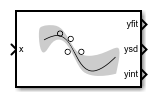 | RegressionGP Predict | Predict responses using Gaussian process (GP) regression model (depuis R2022a) |
 | RegressionLinear Predict | Predict responses using linear regression model (depuis R2023a) |
 | RegressionNeuralNetwork Predict | Predict responses using neural network regression model |
 | RegressionSVM Predict | Predict responses using support vector machine (SVM) regression model |
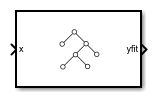 | RegressionTree Predict | Predict responses using regression tree model |
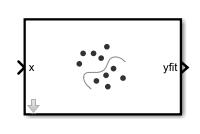 | RegressionKernel Predict | Predict responses using Gaussian kernel regression model (depuis R2024b) |
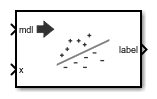 | IncrementalClassificationLinear Predict | Classify observations using incremental linear classification model (depuis R2023b) |
 | IncrementalClassificationLinear Fit | Fit incremental linear binary classification model (depuis R2023b) |
 | IncrementalRegressionLinear Predict | Predict responses using incremental linear regression model (depuis R2023b) |
 | IncrementalRegressionLinear Fit | Fit incremental linear regression model (depuis R2023b) |
 | IncrementalClassificationECOC Fit | Fit incremental ECOC classification model (depuis R2024a) |
 | IncrementalClassificationECOC Predict | Classify observations using incremental ECOC classification model (depuis R2024a) |
 | IncrementalClassificationKernel Fit | Fit incremental kernel classification model (depuis R2024b) |
 | IncrementalClassificationKernel Predict | Classify observations using incremental kernel classification model (depuis R2024b) |
 | IncrementalRegressionKernel Fit | Fit incremental kernel regression model (depuis R2024b) |
 | IncrementalRegressionKernel Predict | Predict responses using incremental kernel regression model (depuis R2024b) |
 | IncrementalClassificationNaiveBayes Fit | Fit incremental naive Bayes classification model (depuis R2025a) |
 | IncrementalClassificationNaiveBayes Predict | Classify observations using incremental naive Bayes classification model (depuis R2025a) |
 | Detect Drift | Update drift detector states and drift status with new data (depuis R2024b) |
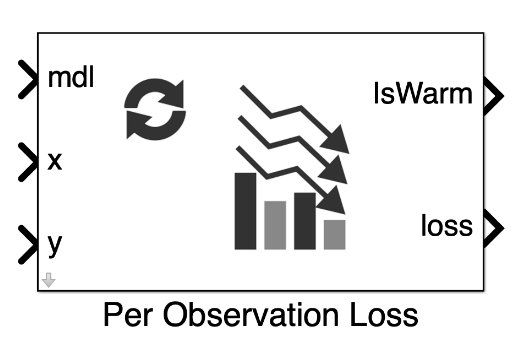 | Per Observation Loss | Per observation regression or classification error of incremental model (depuis R2025a) |
 | Update Metrics | Update performance metrics in incremental learning model given new data (depuis R2023b) |
 | KNN Search | Find k-nearest neighbors using searcher object (depuis R2023b) |
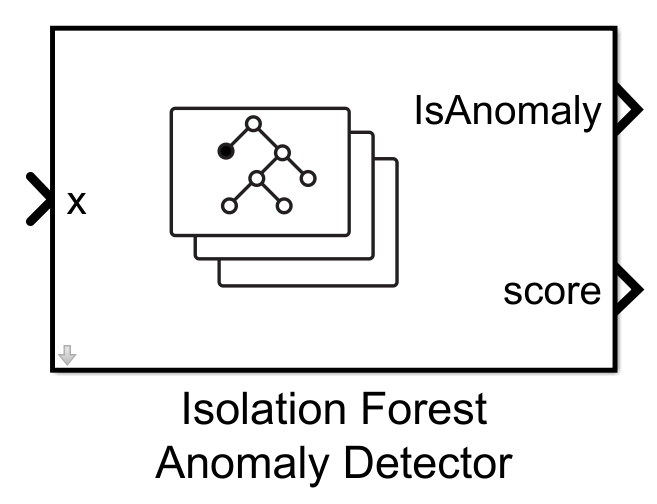 | Isolation Forest Anomaly Detector | Find anomalies in data using isolation forest (depuis R2026a) |
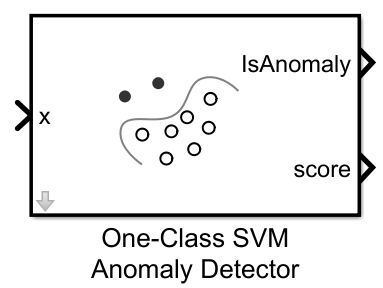 | One-Class SVM Anomaly Detector | Find anomalies in data using one-class support vector machine (SVM) (depuis R2026a) |
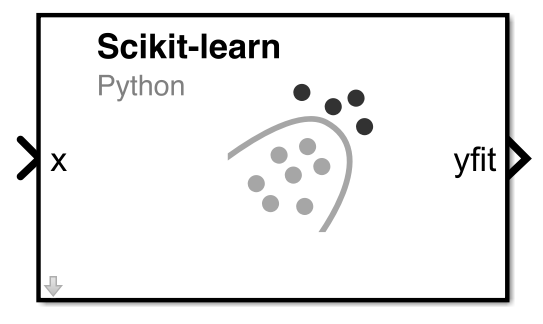 | Scikit-learn Model Predict | Predict responses using pretrained Python scikit-learn model (depuis R2024a) |
 | Custom Python Model Predict | Predict responses using pretrained custom Python model (depuis R2024a) |
Rubriques
Classification
- Predict Class Labels Using ClassificationSVM Predict Block
This example shows how to use the ClassificationSVM Predict block for label prediction in Simulink®. - Predict Class Labels Using ClassificationTree Predict Block
Train a classification decision tree model using the Classification Learner app, and then use the ClassificationTree Predict block for label prediction. - Predict Class Labels Using ClassificationLinear Predict Block
This example shows how to use the ClassificationLinear Predict block for label prediction in Simulink®. (depuis R2023a) - Predict Class Labels Using ClassificationECOC Predict Block
Train an ECOC classification model, and then use the ClassificationECOC Predict block for label prediction. (depuis R2023a) - Predict Class Labels Using ClassificationEnsemble Predict Block
Train a classification ensemble model with optimal hyperparameters, and then use the ClassificationEnsemble Predict block for label prediction. - Predict Class Labels Using ClassificationNaiveBayes Predict Block
Train a naive Bayes classification model, and then use the ClassificationNaiveBayes Predict block for label prediction. (depuis R2024a) - Predict Class Labels Using ClassificationNeuralNetwork Predict Block
Train a neural network classification model, and then use the ClassificationNeuralNetwork Predict block for label prediction. - Predict Class Labels Using ClassificationKNN Predict Block
Train a nearest neighbor classification model, and then use the ClassificationKNN Predict block for label prediction. - Predict Class Labels Using ClassificationDiscriminant Predict Block
Train a discriminant analysis classification model, and then use the ClassificationDiscriminant Predict block for label prediction. (depuis R2023b) - Predict Class Labels Using ClassificationKernel Predict Block
Train a Gaussian kernel classification model, and then use the ClassificationKernel Predict block for label prediction. (depuis R2024b)
Régression
- Predict Responses Using RegressionSVM Predict Block
Train a support vector machine (SVM) regression model using the Regression Learner app, and then use the RegressionSVM Predict block for response prediction. - Predict Responses Using RegressionTree Predict Block
This example shows how to use the RegressionTree Predict block for response prediction in Simulink®. - Predict Responses Using RegressionLinear Predict Block
This example shows how to use the RegressionLinear Predict block for response prediction in Simulink®. (depuis R2023a) - Predict Responses Using RegressionEnsemble Predict Block
Train a regression ensemble model with optimal hyperparameters, and then use the RegressionEnsemble Predict block for response prediction. - Predict Responses Using RegressionNeuralNetwork Predict Block
Train a neural network regression model, and then use the RegressionNeuralNetwork Predict block for response prediction. - Predict Responses Using RegressionGP Predict Block
Train a Gaussian process (GP) regression model, and then use the RegressionGP Predict block for response prediction. - Predict Responses Using RegressionKernel Predict Block
This example shows how to use the RegressionKernel Predict block for response prediction in Simulink®. (depuis R2024b)
Apprentissage incrémental
- Perform Incremental Learning Using IncrementalClassificationLinear Fit and Predict Blocks
Perform incremental learning with the IncrementalClassificationLinear Fit block and predict labels with the IncrementalClassificationLinear Predict block. (depuis R2023b) - Perform Incremental Learning Using IncrementalRegressionLinear Fit and Predict Blocks
Perform incremental learning with the IncrementalRegressionLinear Fit block and predict responses with the IncrementalRegressionLinear Predict block. (depuis R2023b) - Perform Incremental Learning Using IncrementalClassificationECOC Fit and Predict Blocks
Perform incremental learning with the IncrementalClassificationECOC Fit block and predict labels with the IncrementalClassificationECOC Predict block. (depuis R2024a) - Perform Incremental Learning Using IncrementalClassificationKernel Fit and Predict Blocks
Perform incremental learning with the IncrementalClassificationKernel Fit block and predict labels with the IncrementalClassificationKernel Predict block. (depuis R2024b) - Perform Incremental Learning Using IncrementalRegressionKernel Fit and Predict Blocks
Perform incremental learning with the IncrementalRegressionKernel Fit block and predict responses with the IncrementalRegressionKernel Predict block. (depuis R2024b) - Perform Incremental Learning and Track Performance Metrics Using Update Metrics Block
Perform incremental learning and track performance metrics with the Update Metrics block. (depuis R2023b) - Monitor Drift Using Detect Drift Block
This example shows how to use the Detect Drift block for monitoring drift in a data stream in Simulink®. (depuis R2024b) - In-Place Model Update of Offline Linear Model Using IncrementalClassificationLinear Predict Block
Perform in-place model update without regenerating deployed code. (depuis R2025a)
Templates d’apprentissage incrémental
- Configure Simulink Template for Conditionally Enabled Incremental Linear Classification
Configure the Simulink Enabled Execution Incremental Learning template to perform incremental linear classification. (depuis R2024a) - Configure Simulink Template for Conditionally Enabled Incremental Linear Regression
Configure the Simulink Enabled Execution Incremental Learning template to perform incremental linear regression. (depuis R2024a) - Configure Simulink Template for Rate-Based Incremental Linear Classification
Configure the Simulink Rate-Based Incremental Learning template to perform incremental linear classification. (depuis R2024a) - Configure Simulink Template for Rate-Based Incremental Linear Regression
Configure the Simulink Rate-Based Incremental Learning template to perform incremental linear regression. (depuis R2024a) - Configure Simulink Template for Drift-Aware Incremental Learning
Configure the Drift-Aware Training for Incremental Learning template to perform drift-aware learning. (depuis R2025a)
Analyse de clusters et détection d’anomalies
- Find Nearest Neighbors Using KNN Search Block
Train a nearest neighbor searcher model, and then use the KNN Search block for label prediction. (depuis R2023b)
Coexécution avec Python
- Predict Cluster Assignments Using Python Scikit-learn Model Predict Block
This example shows how to use the Scikit-learn Model Predict block for prediction in Simulink®. - Predict Responses Using Custom Python Model in Simulink
This example shows how to use the Custom Python Model Predict block for prediction in Simulink®.
Exporter des modèles des applications Learner vers Simulink
- Export Classification Model to Make Predictions in Simulink
After training a model in Classification Learner, export the model to Simulink. - Export Regression Model to Make Predictions in Simulink
After training a model in Regression Learner, export the model to Simulink.
Génération de code
- System Objects for Classification and Code Generation
Generate code from a System object™ for making predictions using a trained classification model, and use the System object in a Simulink model. - Predict Class Labels Using MATLAB Function Block
Generate code from a Simulink model that classifies data using an SVM model. - Predict Class Labels Using Stateflow
Generate code from a Stateflow® model that classifies data using a discriminant analysis classifier.
Informations connexes
- Deep Learning avec Simulink (Deep Learning Toolbox)
Sélection d՚exemples

Human Activity Recognition Simulink Model for Fixed-Point Deployment
Generate code from a classification Simulink model prepared for fixed-point deployment.
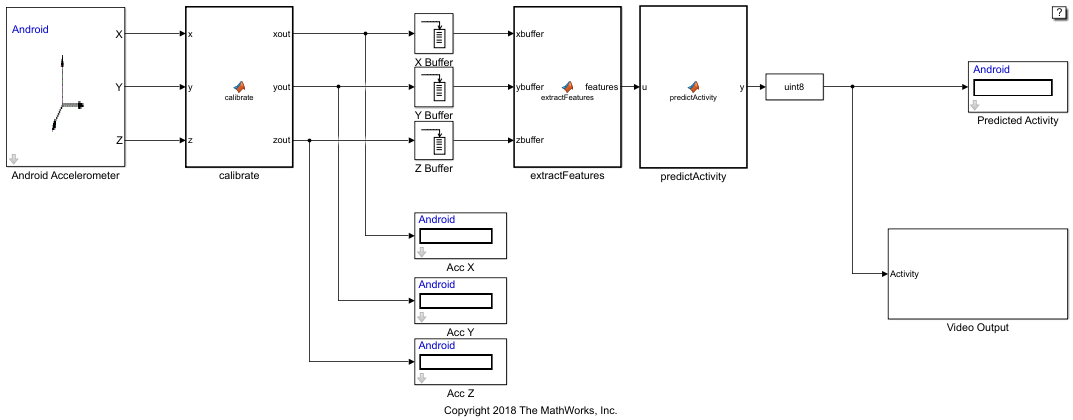
Human Activity Recognition Simulink Model for Smartphone Deployment
Generate code from a classification Simulink model prepared for deployment to a smartphone.
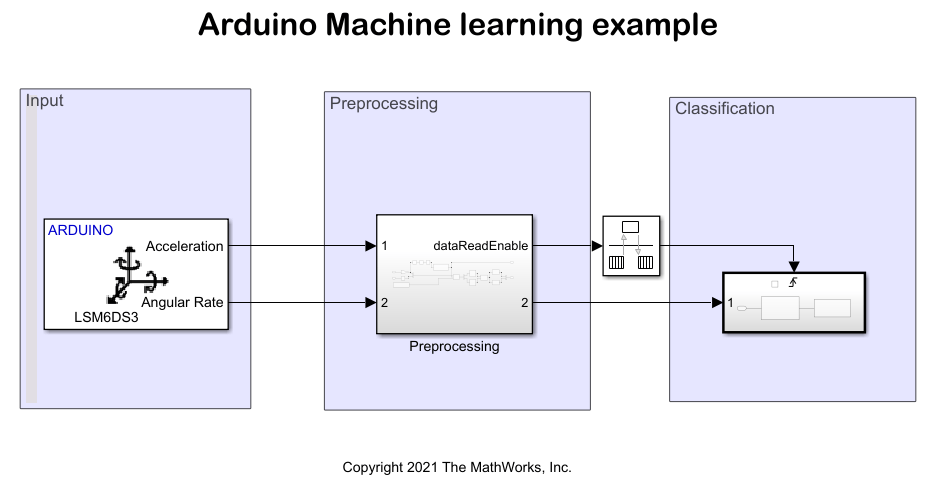
Identify Punch and Flex Hand Gestures Using Machine Learning Algorithm on Arduino Hardware
Use the Simulink® Support Package for Arduino® Hardware to identify punch and flex hand gestures using a machine learning algorithm. The example is deployed on an Arduino Nano 33 IoT hardware board that uses an onboard LSM6DS3 6DOF IMU sensor to identify the hand gestures. The output from the machine learning algorithm, after identifying whether a hand gesture is a punch or a flex, is transmitted to the serial port where 0 represents a punch and 1 represents a flex.
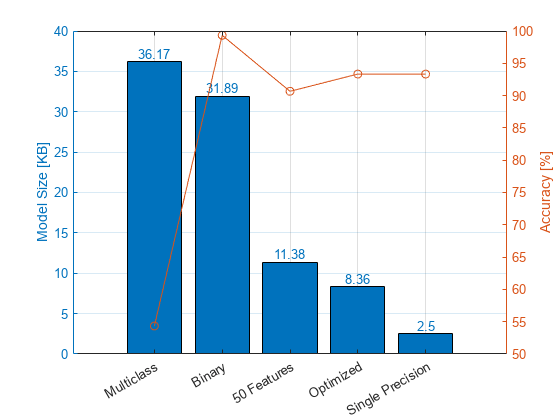
Compress Machine Learning Model for Memory-Limited Hardware
Reduce model size by feature selection, constrained Bayesian optimization, and parameter quantization.

