Histogram Binwidth Optimization

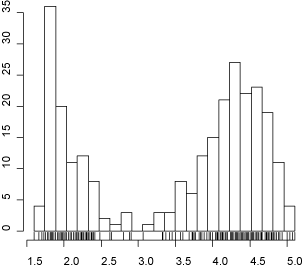
Function `sshist' returns optimal number of bins in a histogram used for density estimation.
3,4K téléchargements
Mise à jour 22 jan. 2010

Afficher la licence

function [optN, C, N] = sshist(x,N)
% [optN, C, N] = sshist(x,N)
%
% Function `sshist' returns the optimal number of bins in a histogram
% used for density estimation.
% Optimization principle is to minimize expected L2 loss function between
% the histogram and an unknown underlying density function.
% An assumption made is merely that samples are drawn from the density
% independently each other.
%
% The optimal binwidth D* is obtained as a minimizer of the formula,
% (2K-V) / D^2,
% where K and V are mean and variance of sample counts across bins with width D.
% Optimal number of bins is given as (max(x) - min(x)) / D*.
%
% For more information, visit
% http://2000.jukuin.keio.ac.jp/shimazaki/res/histogram.html
%
% Original paper:
% Hideaki Shimazaki and Shigeru Shinomoto
% A method for selecting the bin size of a time histogram
% Neural Computation 19(6), 1503-1527, 2007
% http://dx.doi.org/10.1162/neco.2007.19.6.1503
%
% Example usage:
% optN = sshist(x); hist(x,optN);
%
% Input argument
% x: Sample data vector.
% N (optinal):
% A vector that specifies the number of bins to be examined.
% The optimal number of bins is selected from the elements of N.
% Default value is N = 2:50.
% * Do not search binwidths smaller than a sampling resolution of data.
%
% Output argument
% optN: Optimal number of bins.
% N: Bin numbers examined.
% C: Cost function of N.
%
% See also SSKERNEL
%
% Copyright (c) 2009 2010, Hideaki Shimazaki All rights reserved.
% http://2000.jukuin.keio.ac.jp/shimazaki

%%%%%%%%%%%%%%%%%%%%%%%%%%%%%%%%%%%%%%%%%%%%%%%%%%%%%%%%%%%%%%%%%%
% Parameters Setting
x = reshape(x,1,numel(x));
x_min = min(x);
x_max = max(x);

if nargin < 2
buf = abs(diff(sort(x)));
dx = min(buf(logical(buf ~= 0)));
N_MIN = 2; % Minimum number of bins (integer)
% N_MIN must be more than 1 (N_MIN > 1).
N_MAX = min(floor((x_max - x_min)/(2*dx)),50);
% Maximum number of bins (integer)
N = N_MIN:N_MAX; % # of Bins
end

SN = 30; % # of partitioning positions for shift average
D = (x_max - x_min) ./ N; % Bin Size Vector

%%%%%%%%%%%%%%%%%%%%%%%%%%%%%%%%%%%%%%%%%%%%%%%%%%%%%%%%%%%%%%%%%%
% Computation of the Cost Function
Cs = zeros(length(N),SN);
for i = 1: length(N)

shift = linspace(0,D(i),SN);
for p = 1 : SN
edges = linspace(x_min+shift(p)-D(i)/2,...
x_max+shift(p)-D(i)/2,N(i)+1); % Bin edges

ki = histc(x,edges); % Count # of events in bins
ki = ki(1:end-1);

k = mean(ki); % Mean of event count
v = sum( (ki-k).^2 )/N(i); % Variance of event count

Cs(i,p) = ( 2*k - v ) / D(i)^2; % The Cost Function
end

end
C = mean(Cs,2);

%%%%%%%%%%%%%%%%%%%%%%%%%%%%%%%%%%%%%%%%%%%%%%%%%%%%%%%%%%%%%%%%%%
% Optimal Bin Size Selectioin
[Cmin idx] = min(C);
optN = N(idx); % Optimal number of bins
%optD = D(idx); % *Optimal binwidth
%edges = linspace(x_min,x_max,N(idx)); % Optimal segmentation

Citation pour cette source

Hideaki Shimazaki (2026). Histogram Binwidth Optimization (https://fr.mathworks.com/matlabcentral/fileexchange/24913-histogram-binwidth-optimization), MATLAB Central File Exchange. Extrait(e) le .

Compatibilité avec les versions de MATLAB
Créé avec R2009a
Compatible avec toutes les versions
Plateformes compatibles
Windows macOS Linux
Catégories
En savoir plus sur Histograms dans Help Center et MATLAB Answers
Version Publié le Notes de version
1.4.0.0

minor change: manual updated

1.3.0.0

minor change

1.2.0.0

minor change

1.1.0.0

minor change

1.0.0.0