
Vous suivez désormais cette soumission
- Les mises à jour seront visibles dans votre flux de contenu suivi
- Selon vos préférences en matière de communication il est possible que vous receviez des e-mails
No a priori knowledge of the number of bins, or the distance between bins, is required. This approach relies on the relative difference between (sorted) elements of the data, and works well when the difference between clusters is bigger than the difference between elements within a cluster.
SYNTAX:
CLUSTERS = clusterData(DATA);
Operates column-by-column. An optional input allows you to specify the sensitivity of each columnwise clustering. Additional outputs also specify the indices of the cluster each row of data, and the bounds used to separate them.
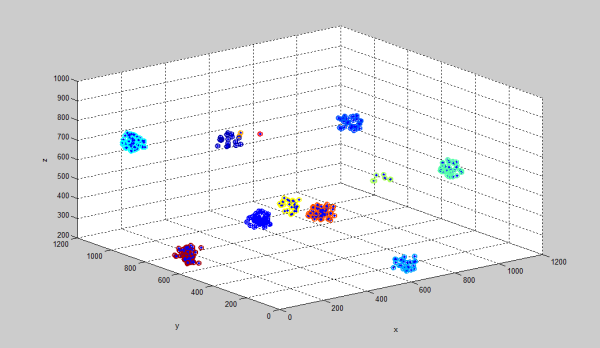
Each column may have a different interpretation. For instance, an Mx4 array of data may represent x-data in the first column, y- in the second, z- in the third, and t- in the fourth. Returns a Px1 cell array, CLUSTERS, specifying the data points in each of the P clusters detected.
The final clustering utilizes all columns.
NOTE: This submission incorporates, expands, and replaces my earlier submission ezCluster.
Citation pour cette source
Brett Shoelson (2026). clusterData (https://fr.mathworks.com/matlabcentral/fileexchange/35014-clusterdata), MATLAB Central File Exchange. Extrait(e) le .
Remerciements
A inspiré : Data clustering using Bat Algorithm
Catégories
En savoir plus sur Statistics and Machine Learning Toolbox dans Help Center et MATLAB Answers
Informations générales
- Version 1.1.0.1 (3,43 ko)
Compatibilité avec les versions de MATLAB
- Compatible avec toutes les versions
Plateformes compatibles
- Windows
- macOS
- Linux
| Version | Publié le | Notes de version | Action |
|---|---|---|---|
| 1.1.0.1 | Updated license |
||
| 1.1.0.0 | Modified the help to correct a doc bug. Higher sensitivity results in fewer clusters, not more. (No code change.) |
||
| 1.0.0.0 |
