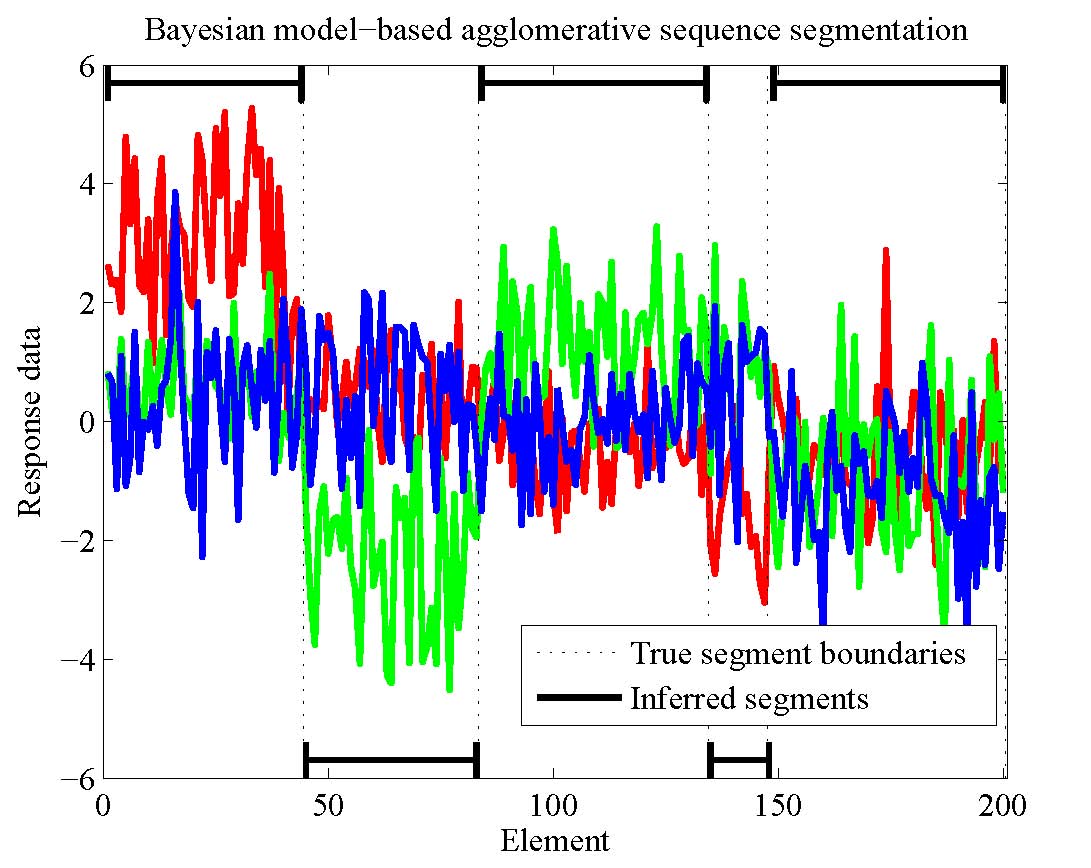
Bayesian model-based agglomerative sequence segmentation
Bayesian algorithm for segmenting real-valued input-output data into non-overlapping segments

Vous suivez désormais cette soumission
- Les mises à jour seront visibles dans votre flux de contenu suivi
- Selon vos préférences en matière de communication il est possible que vous receviez des e-mails
Citation pour cette source
Gabriel Agamennoni (2026). Bayesian model-based agglomerative sequence segmentation (https://fr.mathworks.com/matlabcentral/fileexchange/45292-bayesian-model-based-agglomerative-sequence-segmentation), MATLAB Central File Exchange. Extrait(e) le .
Informations générales
- Version (5,91 ko)
Compatibilité avec les versions de MATLAB
- Compatible avec toutes les versions
Plateformes compatibles
- Windows
- macOS
- Linux
| Version | Publié le | Notes de version | Action |
|---|---|---|---|
| 1.3.0 | Minor bug fix. |
||
| 1.2.0 | Fixed minor typo in documentation. |
||
| 1.1.0 | Fixed minor typos in the documentation. |
||
| 1.0.0 |

